Election 2026: Republican voters choose Graham or Norman on Tuesday
National News

Audio By Carbonatix
7:17 AM on Monday, August 24
Alan Wooten
(The Center Square) – U.S. Sen. Darline Graham, sister of Lindsey Graham, carries the endorsement of second-term President Donald Trump against U.S. Rep. Ralph Norman in South Carolina’s U.S. Senate special Republican primary runoff on Tuesday.
She also has the backing of U.S. Sen. Tim Scott and U.S. Rep. Russell Fry, the third-place finisher two weeks ago. Greenville County, the most populous and heavy contributor to primaries of the party, was won by Norman.
The special election became necessary when Lindsey Graham died July 11. Gov. Henry McMaster appointed Darline Graham to fulfill the remainder of the term in the 119th Congress that ends on the first of January, and she decided to seek the six-year term by succeeding her brother on the Nov. 3 ballot.
From a crowded field, and after a failed run for governor in the June primary, Norman emerged second to Graham in the special primary two weeks ago. Without achieving 50% plus one of the votes, a runoff was necessary.
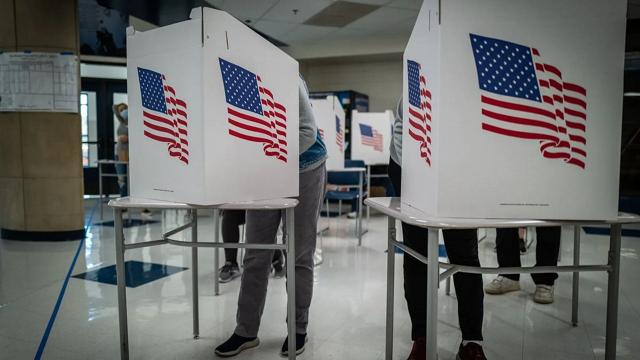
Early in-person voting ended Saturday.
Trump endorsements in primaries for 2026, according to Ballotpedia, is 96%. Among the 4% failing were his pick for the governor in South Carolina. He backed Lt. Gov. Pamela Evette, and she was soundly defeated 68.6%-31.4% in a runoff against four-term Attorney General Alan Wilson with more than 318,000 votes cast.
Lindsey Graham’s bread-and-butter was national security and foreign policy – so much so that the timing of the funeral accommodated scheduling for Ukraine President Volodymyr Zelenskyy, Israel Prime Minister Benjamin Netanyahu and Finland President Alexander Stubb. It may, however, be a thorn if there is a downfall for Darline Graham.
At last week’s debate in Columbia, she struggled on a question about Taiwan and the South China Sea and told the audience, “National security is not my thing.”
Norman said, “This isn’t a get training on the job, you can’t do that.”
Trump was at the Myrtle Beach Convention Center on Friday in support of Graham.
In the aftermath of the debate, Graham took ownership of her lack of experience in foreign policy. She also, at the debate, acknowledged its importance while contrasting what she believes in voters.
“They’re worried about their pocketbooks more than they’re worried about the South China Sea, quite honestly,” Graham said.
Graham and Norman advanced in an election, attracting just 11.1% of more than 3 million eligible voters. Dr. Annie Andrews, a Charleston pediatrician, is the Democratic opponent in November and is joined on the ballot by Libertarian Kasie Whitener.
Graham collected 32.8% of the votes – 109,881 of the 335,693 cast. Norman was next at 24.6% (82,627).
They were followed by Fry (19.7%), former Gov. Mark Sanford (14.9%), Mark Lynch (5.9%), Danny Ford II (0.8%), Duke Buckner (0.5%), Glenda Gail Parker (0.3%), Sam Shepherd (0.3%) and Mark McBride (0.2%).
In the June primary, Lindsey Graham easily bested five challengers including second-place Lynch (56.8%-28.9%). He was bidding for a fifth term.
This Senate seat is one of 33 in regular rotation for the 2026 midterms nationwide, and there are also two special elections. Majority control rests with Republicans at 53 seats, and contests in North Carolina, Georgia, Ohio, Michigan, Maine, Iowa, New Hampshire, Alaska, Texas and Montana figure to determine if Trump's agenda the next two years will stall in the chamber.
The victor between Graham and Norman will be heavily favored in two months. There hasn’t been a Democrat from the state in the U.S. Senate since Sen. Fritz Holdings retired in 1998.
Republicans have also dominated statewide offices for more than a decade. And they've done so in legislative districts.
Today's state Senate is 34-12 Republican majority, and the House of Representatives is 88-36 Republican majority. Republicans have had majorities for seven four-year cycles in the Senate, dating to 2000, and 16 two-year cycles in the House, dating to 1994.